
 This image is licensed under Creative Commons License.
- Thursday, 29. September 2016 4:00 pm – 6:30 pm Save in my calendar
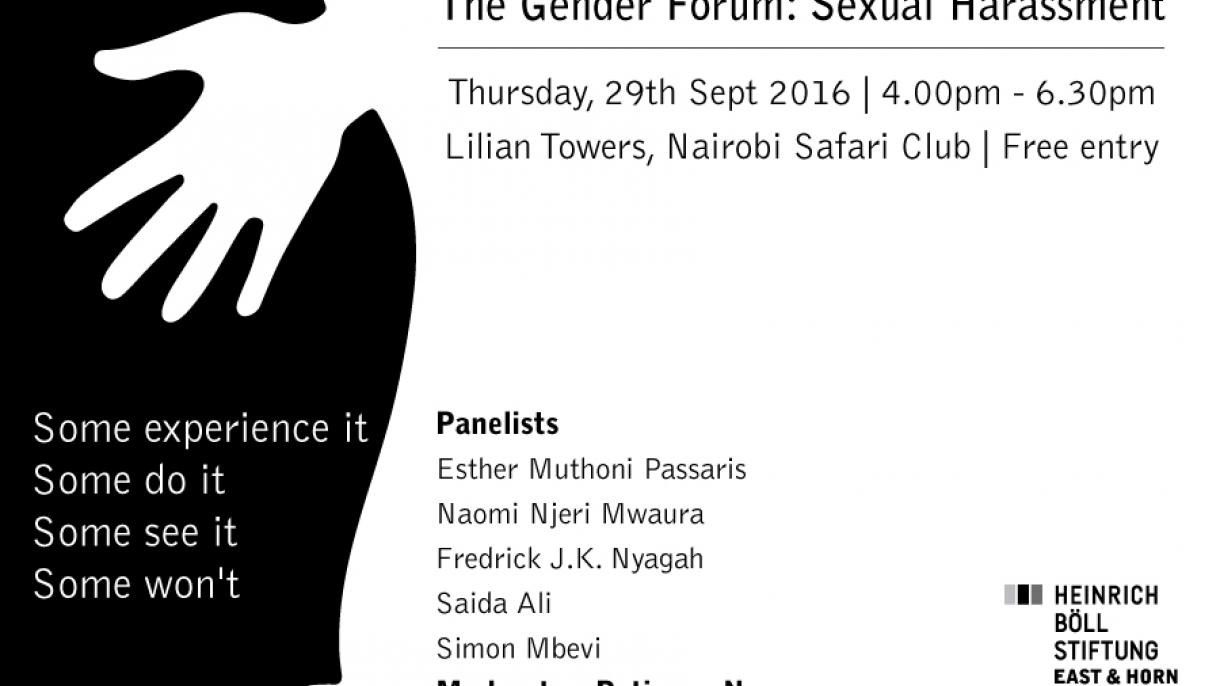
Gender Forum: Sexual Harassment
Thursday 29th September 2016 | Lilian Towers, Nairobi Safari Club | 4:00pm - 6:30pm | Free entry to all audiences
Is sexual harassment an issue in Kenya? In 2006 the Honourable Njoki Ndungu, lobbied for legislative change through the Sexual Offences Bill. The bill was an important step to addressing sexual offences since it consolidated all laws relating to complaints of this nature and repealed most of the provisions in the Penal Code relating to sexual offence. At the point of lobbying for the bill, Hon. Njoki outlined critical challenges. The gender related ones included Kenya’s conservative culture, chauvinism and gender power relations.
Sexual harassment is not unique to Kenya - its prevalence goes beyond our borders. Key examples of rape and consequent murder includethe Delhi gang rape of Jyoti Singh Pandey as well as that of South African Anene Booysen. The cases of Jyoti and Anene are now known to us because their families, outraged citizens and civil society organizations were critical in humanising their stories and seeking justice.
In Kenya we have examples that illustrate the same shape and form of sexual harassment. Presently, there are two cases that are pending in court. The first is the case of a woman who was stripped in Kayole – recall #MyDressMyChoice. The perpetrators are still in jail after being denied bail. The second is the case of Njeri. On October 11th 2015, Njeri was raped and murdered in Kikuyu by an unknown perpetrator.
It is observable that the cases highlighted above are not isolated. Women experience sexual harassment in their everyday lives and the reason why we do not hear about it is because, they are taken for granted and therefore normalised, or they are widely ignored. More than this, even as the Sexual Offences Bill is in place, questions still abound as to whether the justice system is well equipped to protect women from sexual harassment.
The goal of this forum is to bring together scholars, activists and women who have faced sexual harassment, to push the dialogue of rights further and explore alternative ways in which sexual harassment can be addressed.
Key discussion points:
- Should sexual harassment be a political priority?
- What are some of the ways that sexual harassment takes shape?
- What are some of the ways that women can be assured of justice?
Invited Speakers:
- Esther Muthoni Passaris OGW
- Naomi Njeri Mwaura – Flone Initiative, a workforce development organization working in the matatu industry
- Fredrick J.K. Nyagah – Gender Advisor in Global Communities (formerly CHF International) and Founder National Chairman of MenEngage Kenya Network
- Saida Ali – International Policy Analyst
- Simon Mbevi - Founder and Director of Transform Nations
Moderator: Patience Nyange – Senior Human Rights Officer, Kenya National Commission on Human Rights
Format of Discussion:
A panel discussion contextualizes issues to the audience. This is infused with public dialogue and Q&A where the audience engages with the panel and forum.
About the Foundation
Being part of the Green political movement that has developed worldwide as a response to the traditional politics of socialism, liberalism, and conservatism, the Heinrich Böll Stiftung is a Green Political Foundation, affiliated to the German political party “Alliance ’90 / The Greens”. The regional office for East and Horn of Africa is a people-centric green think-tank, based in Nairobi since 2001. In our work, we facilitate open dialogue, undertake studies and forge partnerships with and among communities in East & Horn of Africa along the core themes of Gender, Environment, Democracy and International Dialogue.
About the Gender Forum
The Gender Forum is a monthly public dialogue convened by the Heinrich Böll Stiftung since 2001, encouraging dialogue on pertinent national social issues with a gendered lens. It brings together scholars, law- makers and implementers, civil activists, government institutions, students and the general public, aiming at sharing knowledge and inspiring gendered analysis of policy and programmes.
Join the conversation online via #GenderForum.
Files
- Part of the series
- Gender Forum
- Entrance Fee
- Free