
Discussion evening
- Wednesday, September 30, 2026 6:00 pm – 9:30 pm Save in my calendar
Maghreb Matters – Morocco
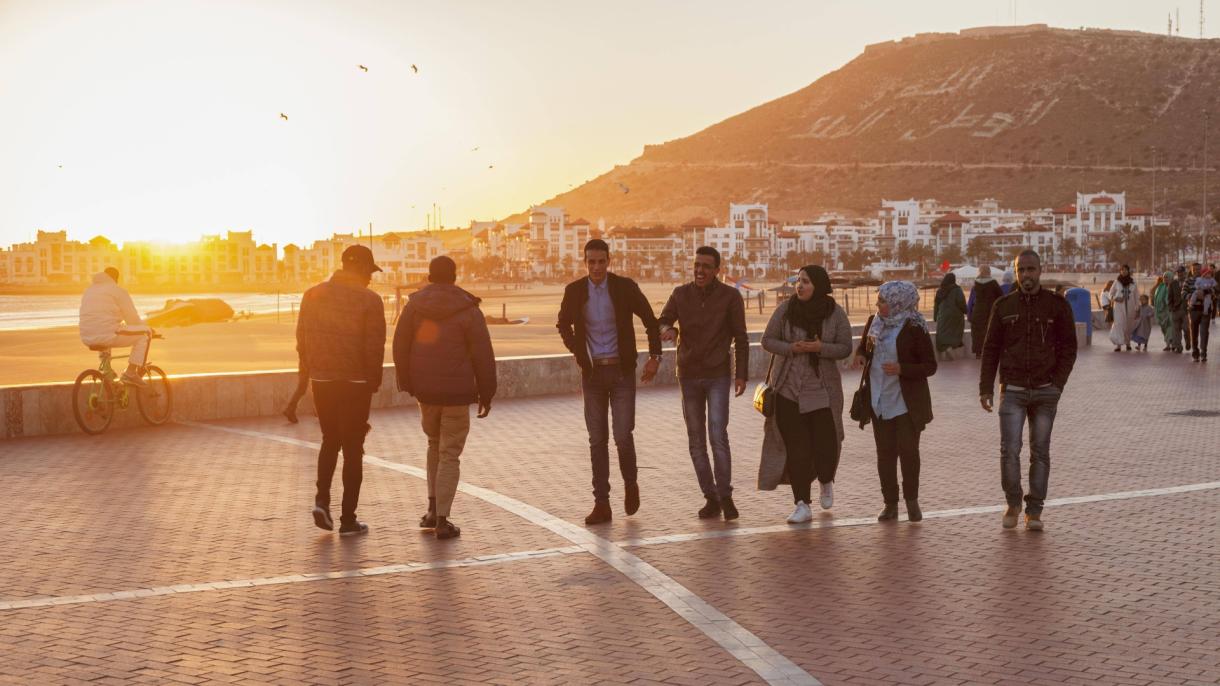
Participation, transparency and future prospects: What are the dreams of Morocco’s youth?
Against the backdrop of regional conflicts and global crises, Morocco has become an indispensable partner for the European Union and Germany in North Africa. The Kingdom is Germany’s second-largest trading partner on the African continent and, at the same time, a key partner in cooperation on energy and migration issues, the immigration of skilled workers and the fight against terrorism.
Nevertheless, developments in the country often receive only sporadic attention in Germany. That changed at the end of July 2026: tens of thousands of young Moroccans attempted to reach the Spanish exclave of Ceuta. The events dominated the headlines for days. Most of them turned back, but what remained were over 80 fatalities and a sense of hopelessness amongst Moroccan youth. Despite the growing economy, many want to leave the country – they lack prospects, a sense of participation and self-determination.
Already by September 2025, thousands of young people had organised themselves on the online platform Discord, subsequently taking to the streets to demand greater transparency and reforms to the education and healthcare systems. However, the government is relying heavily on the 2030 Football World Cup, which is to be held in the country, as a driving force for modernisation and international visibility. Investment in associated infrastructure projects is immense: Across the country, alongside the expansion of sports infrastructure, new motorways, a high-speed rail line and deep-sea ports are being constructed. Meanwhile, high youth unemployment, significant regional income disparities and the looming threat of water scarcity pose major challenges to the political leadership. Added to this are structural problems in the health and education systems, exacerbated by the pandemic.
On 23 September 2026, Moroccan citizens will elect a new parliament. One week after the election, and one year since the Gen Z protests, we will discuss the issues affecting the Kingdom with Moroccan journalists, academics, and activists. What trends can be identified from the parliamentary elections? What issues should the new government prioritise, and how can the structural problems in the health and education systems be addressed? How can the entire population benefit from the country’s development? How can Morocco, Germany, and the EU leverage their strategic partnership to advance reforms? What do developments in Morocco mean for German foreign and development policy?
To start the evening, we will show the 2026 documentary “Gen Zine” and hold a discussion with the director, Fatym Layachi, and the producer, Younes Lazrak. What are young people’s dreams, and what can give them hope? After a short break, our panelists will continue the discussion on Morocco’s political situation.
Agenda
Part 1 (6.00 pm – 7.15 pm) | Participation only on site
Screening of the documentary film “Gen Zine” about the dreams of Moroccan youth (currently being filmed, 25–30 minutes), followed by a discussion.
Approx. 30-minute break with refreshments
Part 2 (8.00 pm – 9.30 pm) | Participation on site & Livestream
Panel discussion “What is driving Morocco four years ahead of the 2030 World Cup”
- Omar El Hyani, Politician, City Council Member (Fédération de la gauche démocratique - FGD), Rabat
- Mustapha El Mnasfi, Researcher, Université Moulay Ismail, Meknès
- Dounia Mseffer, Journalist, Réseau marocain des journalistes des migrations, Casablanca
- Isabelle Werenfels, Senior Fellow, Stiftung Wissenschaft und Politik, Berlin
Facilitation: Anja Hoffmann, Director, Heinrich Böll Foundation, Rabat
Maghreb Matters
This evening event forms part of the ‘Maghreb Matters’ programme – a series of events organised by the Middle East and North Africa Department of the Heinrich Böll Foundation. The series focuses on the Maghreb states, examining current political, social and cultural developments in the region. Our aim is to foster dialogue between experts, activists, decision-makers and an interested audience.
Information:
Philipp Straub
Senior Programme Officer North Africa
Heinrich Böll Foundation
E straub@boell.de
- Timezone
- HEC
- Address
-
▶ Heinrich-Böll-Stiftung, Headquarters Berlin and Online
- Accessibility
- Language
- German
- English
- French
- Livestream
- Watch livestream
Your participation in the event
On-site participation at the Heinrich Böll Foundation Conference Centre, Schumannstr. 8, 10117 Berlin
Please register. Unfortunately, the number of places is limited. If the room capacity is exhausted, we will broadcast the event via video to other rooms. Please note that there is no guarantee of a place in the hall.
Accessing our building
- The entrance to our building is wheelchair-friendly.
- The front entrance is equipped with an accessible intercom system.
- A parking spot for disabled persons can be provided upon request.
- Our event space is on the first floor (US: second floor).
- The building is equipped with an elevator.
- Accessible toilets / bathrooms are available on the ground floor level.
Wheelchair spaces
In our event spaces we provide dedicated spots for wheelchair users.
All tables come with a wheelchair clearance.
For further questions please contact our event staff.
Further information on accessibility can be found here.
Alternatively, you can follow the event via livestream without registering.
Livestream in German
Livestream in English
Livestream in French