
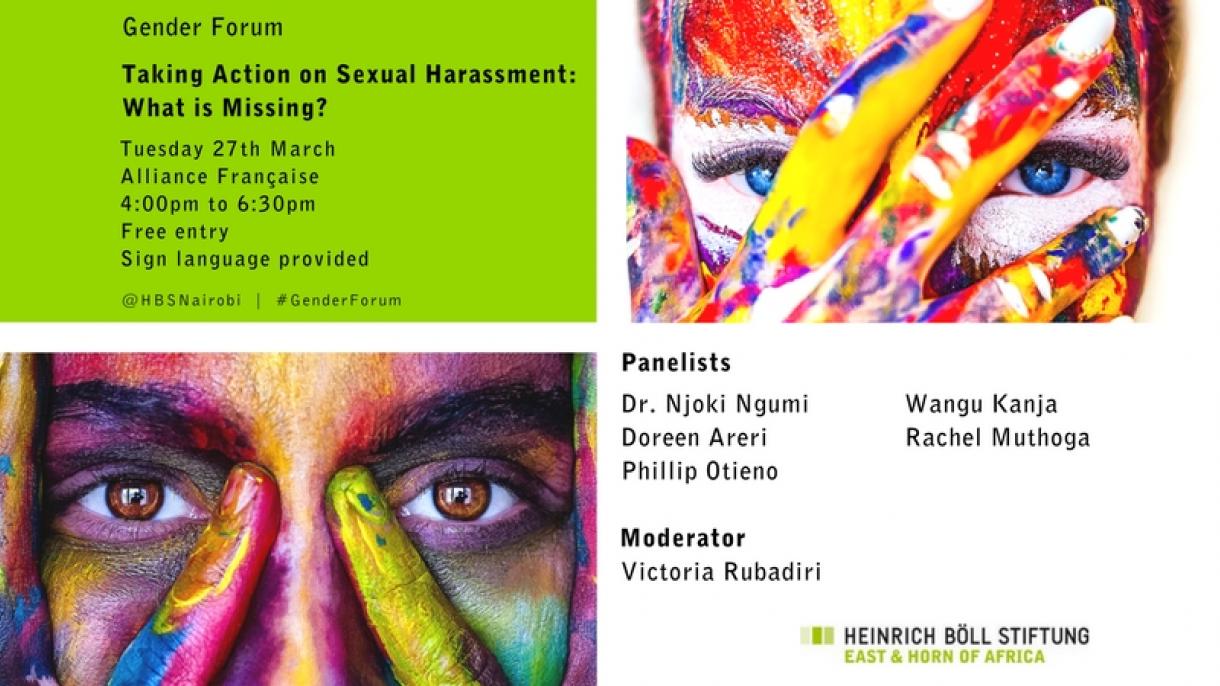
Forum
- Tuesday, 27. March 2018 4:00 pm – 7:00 pm Save in my calendar
Taking Action on Sexual Harassment: What Is Missing?
Sexual harassment and assault have been high-profile topics in the recent months nationally and also internationally.
According to a study conducted by the International Labour Organisation (ILO),”Sexual harassment is inextricably linked with power and often takes place in societies which treat women as sex objects and second-class citizens.” A common example is when women are asked for sexual favours in return for a job, a promotion, or a raise ‘Quid Pro Quo harassment’.
Importantly, sexual harassment is not the same as a mutually-agreed flirtation or relationship. It is an unwelcome action, causes offense and distress, and can in some situations, be physically and emotionally draining to the victim. The victim can feel intimidated, uncomfortable, embarrassed, or threatened. Section 42 of the Sexual Offences Act in Kenya defines consent in the circumstance as a situation where a person agrees by choice, and has the freedom and capacity to make that choice.
Sexual harassment in Kenya is often portrayed as murky or ambiguous in legislation, on the grounds that it’s hard to tell the difference between a bit of banter and a humiliating remark. It is often viewed from the workplace standpoint and as such is defined in section 6 of the Employment Act, 2007 as a situation where:
- A person directly or indirectly requests for sexual activity from another, usually a subordinate, with an express or implied promise of preferential treatment (e.g. higher salary, promotion).
- A threat of adverse consequences (such as being fired, a poor performance review).
- Sexual harassment can also take the form of unwelcome or offensive behavior of a sexual nature
- Use of language or visual material which makes the subject uncomfortable (sending texts, nude photos, porn).
Section 23 of the Sexual Offences Act, 2006 goes further to criminalize it. Sadly, this provision only applies to public officers and persons in position of authority. Some form of sexual harassment may be classified as indecent acts; whereby an indecent act is defined as any contact with the genital organs, breasts or buttocks of another but without penetration (this includes groping, spanking and such acts), or exposure or display of any pornographic material to any person against their will (for example forwards of nudes, suggestive texts).
With this background, the notable increase in cases of and the evolution of sexual harassment which now includes cyber/ online harassment, the gender forum will seek to converse on what more can be done and how the shift of narrative from the issue being a purely law and order problem can help reshape the subsequent conversations.
Key discussion points:
- How to define sexual harassment and what entails the sufficient grounds for reporting?
- How to identify sexual harassment; what is the difference between a bit of banter and a humiliating remark?
- What is missing in the various frameworks that aim to curb sexual harassment in the country?
- What are the prosecutorial challenges with relation to sexual harassment?
Discussion Panel:
The discussion panel comprises of;
- Dr. Njoki Ngumi - The Nest Collective
- Doreen Ireri - Lawyer
- Wangu Kanja - Wangu Kanja Foundation
- Rachael Muthoga – Deputy CEO KEPSA
- Philip Otieno - Men For Gender Equality Now
Moderator: Victoria Rubadiri - NTV Anchor/Reporter
Files
- Address
-
➽ See event description