
Webinar
- Thursday, 24. September 2026 5:00 pm – 6:30 pm Save in my calendar
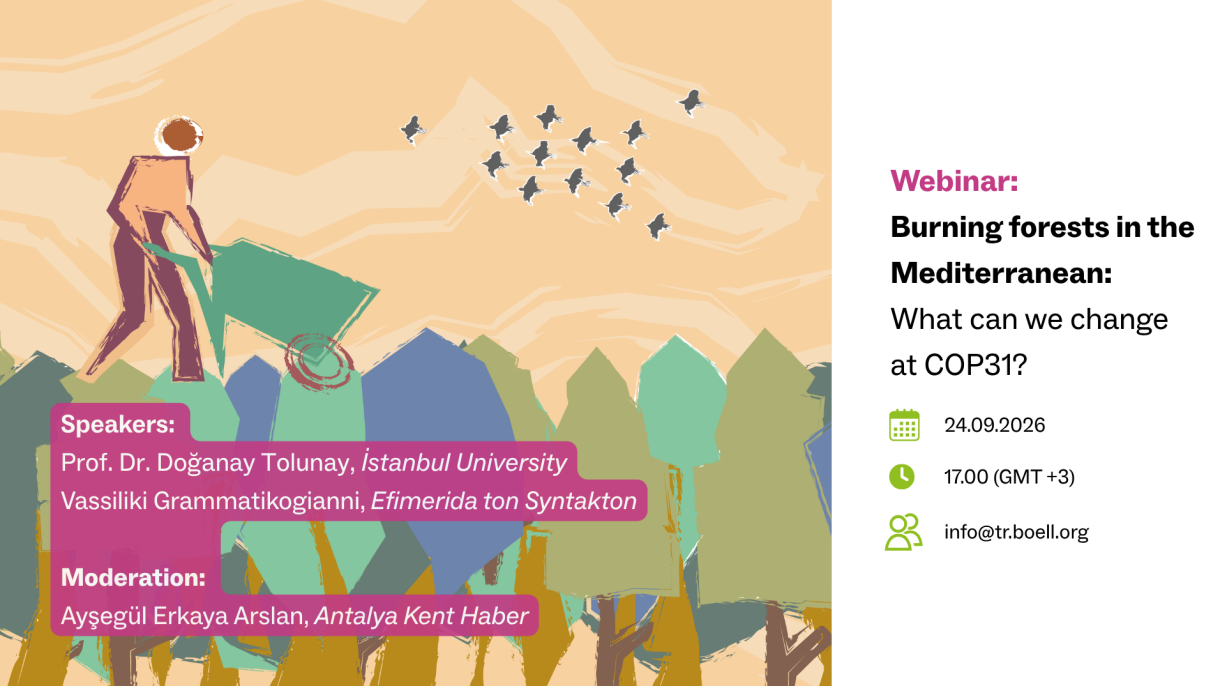
Burning forests in the Mediterranean: What can we change at COP31?
On 7 September, a forest fire broke out in Aksu, a district of Antalya, the city that will host COP31. Starting in Aksu, the fire spread to Kepez and Döşemealtı and was only brought under control after 67.5 hours. 720 people from 254 households were evacuated, and one person lost his life. Fires also broke out in Kumluca and Serik. The total area burned in Aksu has not yet been officially announced. Five years ago, the fires that spread from Manavgat damaged some 60,000 hectares.
Last year, the “Call to Action on Integrated Fire Management and Wildfire Resilience” was launched at the COP30 Leaders’ Summit in Belém. The call, whose signatories include Türkiye and Greece, envisages a shift from a suppression-focused approach to one based on prevention. It also calls for integrating fire management into national climate plans, tackling illegal activities that profit from fires, and restoring burned areas with native vegetation. However, it is a voluntary commitment, and wildfires do not feature as a separate item on the official agenda of the summit in Antalya.
Wildfires cannot be explained by heat and drought alone. Most fires are human-caused. Roads, power lines, settlements, and the mining, energy and tourism permits granted in forests all directly affect the risk. After every major fire, the same question comes up: What will happen to the burned areas? Meanwhile, a new omnibus bill in the Turkish Parliament would pave the way for allocating forests through the carbon market and for removing certain areas from forest boundaries. Forests are counted as carbon stores in climate targets. Yet how reliable a forest that can burn is as a carbon store is another question.
Public debate also struggles to reflect this complexity. In both Türkiye and Greece, discussion after major fires tends to revolve around arson claims and response capacity. Data on the causes of fires reaches the public only to a limited extent. The debate often ends before it reaches the climate crisis that is fuelling the fires, and the fossil fuels behind it.
In this session, we will look for answers to the following questions with a scientist and a journalist from the two shores of the Aegean:
- Why are wildfires becoming more frequent and larger? How do the climate crisis and human factors interact?
- What does shifting from suppression to prevention mean in practice? To what extent are Türkiye and Greece meeting the commitments of the call they signed in Belém?
- Who decides the future of burned areas, and how?
- Given the risk of fire, how realistic is it to treat forests as carbon stores or as instruments of the carbon market?
- How do we talk about wildfires? How can the gap between arson narratives and the data be closed?
- What should we demand from COP31 in Antalya on wildfires?
Speakers:
Prof. Dr. Doğanay Tolunay, Head of the Soil Science and Ecology Division, Department of Forest Engineering, Faculty of Forestry, Istanbul University-Cerrahpaşa
Prof. Dr. Doğanay Tolunay began his academic career in 1991 as a research assistant at the Faculty of Forestry of Istanbul University, completing his master’s degree in 1992 and his PhD in 1997 in the same division. He works on climate change, forest ecology, soil science, land degradation and carbon sequestration. He has served as principal investigator and researcher in numerous national and international research projects supported by TÜBİTAK and other institutions. He is among the independent experts of the UN Convention to Combat Desertification (UNCCD). As a member of the Forestry Science Committee of the Tarım Orman-İş trade union, he contributed to the union’s 2025 Report on Combating Forest Fires. He is known for his public commentary on wildfires, post-fire restoration and forestry policy.
Vassiliki Grammatikogianni, Efimerida ton Syntakton
Vassiliki Grammatikogianni is a Greek journalist working on the environment and climate. She studied journalism and economics, began her career in 1987 and has since worked with numerous magazines, newspapers and websites. In 2010 she founded the “ECOVOICE” column in Athens Voice, and in 2016 she launched europepolis.com, a website focusing on the environment and European affairs. She currently works for the weekend edition of Efimerida ton Syntakton. She follows and reports on the UN climate summits (COPs). She was the only Greek environmental journalist invited to the 2015 UN Summit at which the Sustainable Development Goals were adopted. She is a founding member of the Greek section of the Association of European Journalists. In recognition of her environmental journalism, she received the Oikopolis award in 2014 and the award of ELLET (Hellenic Society for the Protection of the Environment and Cultural Heritage) in 2016.
Moderator:
Ayşegül Erkaya Arslan, Antalya Kent Haber
Ayşegül Erkaya Arslan is Managing Editor at Antalya Kent Haber. She holds a bachelor’s degree in Journalism from Istanbul Arel University and a master’s degree in Media and Cultural Studies. After graduating, she held various positions in civil society organisations and then worked as a freelance journalist for about four years.
Interpreter & languages: Müge Yıldırım, English-Turkish
- Timezone
- GMT+3
- Address
-
➽ Online Event
- Organizer
- Heinrich-Böll-Stiftung Istanbul - Turkey
- Language
- English
- Turkish
- Access
- https://us06web.zoom.us/j/82074497174