
 This image is licensed under Creative Commons License.
Congress
- Thursday, March 26, 2026 – Sunday, March 29, 2026 Save in my calendar
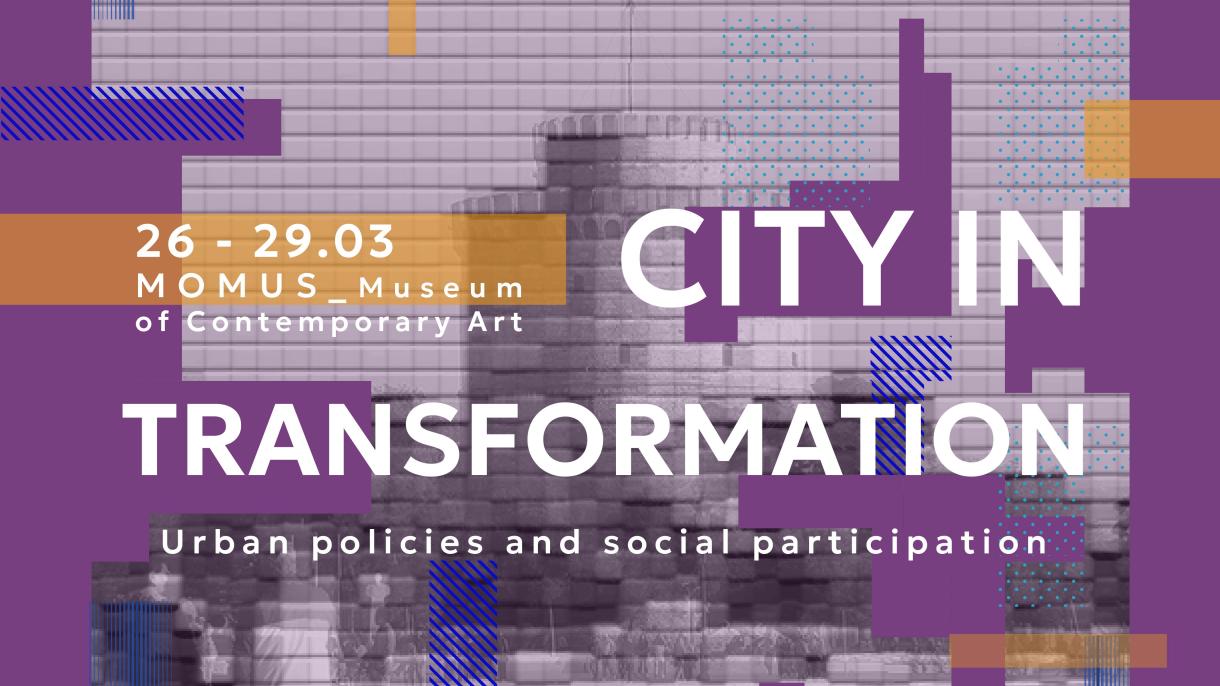
City in Transformation
Urban Policies and Social Participation
Venue: MOMUS–Museum of Contemporary Art and additional locations
Organized by: Commonspace, Participatory Lab
Supported by: Heinrich Böll Foundation – Thessaloniki Office
Contemporary urban transformation is not a neutral technical process, as it is often presented in dominant discourse, but a political field marked by intense conflicts over the shaping of space, the economy, and society. Thessaloniki is no exception.
Across neighborhoods and squares, movements, commons, and solidarity initiatives are emerging, redefining the relationship with public space. These practices are not limited to momentary protests; they often crystallize into permanent structures: from the Neighborhood Urban Planning Committee of Karatasiou Park to the Organizing Committee of the Referendum on the site of the Thessaloniki International Fair, and from self-managed social spaces to cooperatives throughout the city. These practices—with all their limits and difficulties—test and enact different urban everyday lives, producing an alternative urban imaginary grounded in collective claims and solidarity.
Opposite these images of participation and democracy, there is also an image of Thessaloniki being transformed to host and serve its new “users”: investors and tourists.
From the financial crisis years to today, Thessaloniki has experienced its own “neoliberalization”: the public sphere shrinks, the public sector retreats in favor of the private, and the city’s needs become aligned with the needs of investors—as seen in investments and gentrification on the city’s western side.
Technical infrastructures and large-scale projects are implemented through fast-track procedures and decisions, bypassing residents’ and movements’ reactions and resistance. Often, it is unclear at what scale and by which bodies major urban projects—such as the flyover—are designed while in other cases projects clash with existing urban functions. Public consultation on “development” priorities is either purely formal or—in many cases—absent altogether.
Social infrastructures and housing are transformed to meet the needs of thousands of visitors and tourism capital, as is happening in many cities across Greece. Hotels, food services, and entertainment come to the forefront, sidelining traditional commerce and the housing needs of lower-income groups.
The conference “City in Transformation: Urban Policies and Social Participation”, organized by commonspace and participatoryLAB with the support of the Heinrich Böll Foundation – Thessaloniki Office, seeks to explore these issues. Following the recent conference in Athens, we examine the city through its transformations and conflicts, through its geography, history, economy, and productive forces.
From Thursday 26 to Sunday 29 March 2026, we meet at MOMus–Museum of Contemporary Art and at various locations across the city to analyze and understand contemporary urban transformations in Thessaloniki. The program includes discussions, workshops, walking tours, and exhibitions inside and outside the museum.
We engage with researchers, experts, social movements, and citizen initiatives to strengthen those practices that position the city as a space of collectivity and democratic pluralism, of multiple identities and encounters.
We invite you to participate so that we can collectively discuss and shape a heterogeneous yet persistent space of social participation around Thessaloniki’s urban questions.
- Address
-
➽ See event description
- Language
- Greek