
Panel discussion
- Monday, February 16, 2026 7:00 pm – 8:30 pm Save in my calendar
Is Europe the enemy? In discussion with David Sanger and Anna Sauerbrey
In cooperation with Bard College Berlin
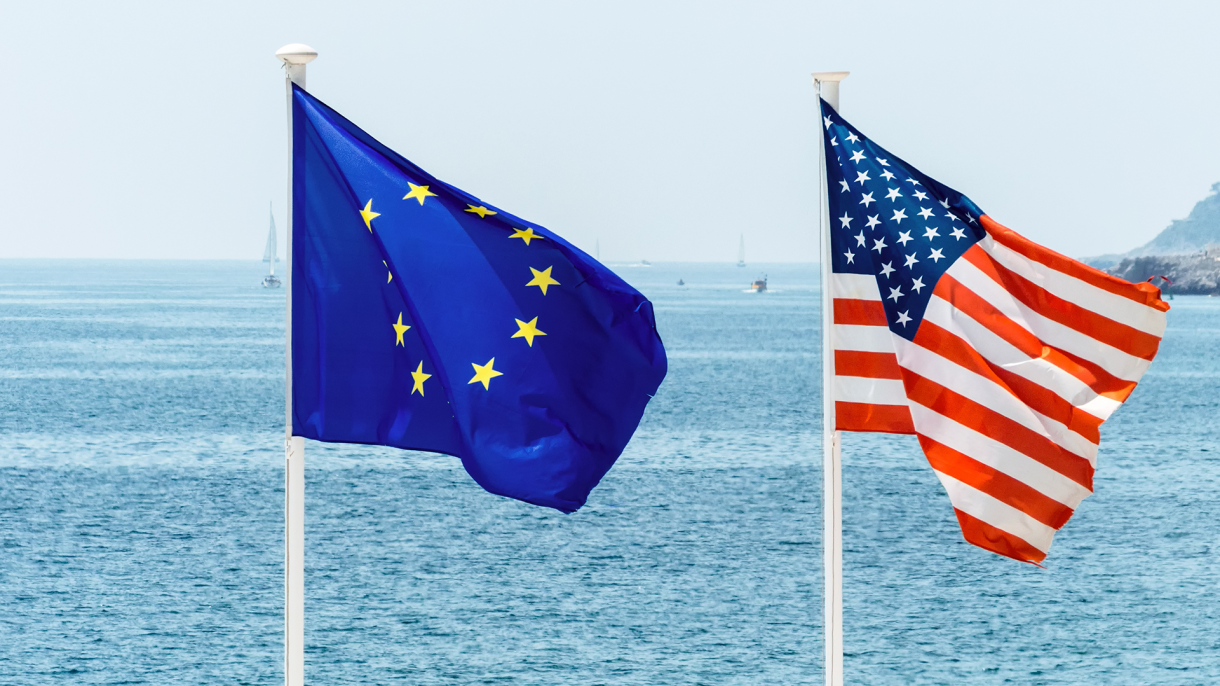
U.S. President Donald Trump's stated plans to annex Greenland have upended security, trade, and diplomatic policy across Europe, not to mention shattered expectations of the possible. The United States, the continent's historic partner and guarantor of security, now looks less an ally than outright antagonist. Is the transatlantic relationship, as it has existed for eighty years, functionally dead? Does Europe have its own strategy in response? German Chancellor Friedrich Merz declared that Europe's long-standing Pax Americana "no longer exists in the way we once knew it." This current U.S. administration certainly has a declared interest, and a track record of action, that suggests a fundamental break with decades of history and precedent, including a newfound antagonism toward modern Europe and its values.
Last year, the Trump administration published a new U.S. national security strategy that laid bare truths that had been developing in the background for some time: namely, under Trump, the United States views European institutions and even some European governments as problems to be circumvented or even overcome. It now appears that Washington considers Europe's rules and laws a burden; its embrace of immigration and multiculturalism, a civilizational mistake. The U.S., then, must find common cause with parties and individual figures who seek, as the strategy document purports, to restore European "sovereignty" and a "traditional European way of life." That is code for Europe's ascendant far-right and Eurosceptic populist movements.
This high-level panel discussion, featuring David Sanger of The New York Times and Anna Sauerbrey of Die Zeit, moderated by Joshua Yaffa, "Writer in residence" at Bard College Berlin, will attempt to describe and diagnose this current moment, and understand the implications for Germany and its European neighbors. Have allies become antagonists? Is that course reversible? And if not, what does this new era in U.S.-European relations mean for the future of politics and society on both sides of the Atlantic?
With:
- David Sanger, White House and National Security Correspondent, The New York Times
- Anna Sauerbrey, Foreign Policy Coordinator, Die Zeit
Moderation: Joshua Yaffa is the inaugural Writer in Residence at Bard College Berlin. He is a contributing writer at The New Yorker and the author of Between Two Fires: Truth, Ambition, and Compromise in Putin’s Russia, which won the Orwell Prize in 2021.
The discussion will be followed by a Q&A.
This event will be held in English.
Contact:
Deitra Myers
Division European Union and North America
Heinrich Böll Foundation Berlin
E myers@boell.de
» Participation on site
Publix, Hermannstraße 90, 12051 Berlin
Please register in advance. Unfortunately, the number of seats for this event is limited.
» Livestream
Alternatively, you can follow the event via livestream.
This event is a continuation of a Bard College Berlin’s and the Heinrich Böll Foundation’s 2025 event series, “Writing Democracy: Stories, Ideas, and Arguments On and Off the Page.” The series brings prominent journalists and writers to a wider Berlin and German audience to discuss topics of civic and political interest in both Germany and the United States. Through the lens of writing, the series offers a broader exploration of democracy and democratic institutions in the transatlantic context: about politics and society in the U.S. and Europe, the lessons of history, the role for democratic values, and misconceptions on both sides of the Atlantic – all with the aim of strengthening transatlantic ties in a trying moment.
Cooperation Partner
