
Webinar
- Wednesday, 09. September 2026 5:00 pm – 7:00 pm Save in my calendar
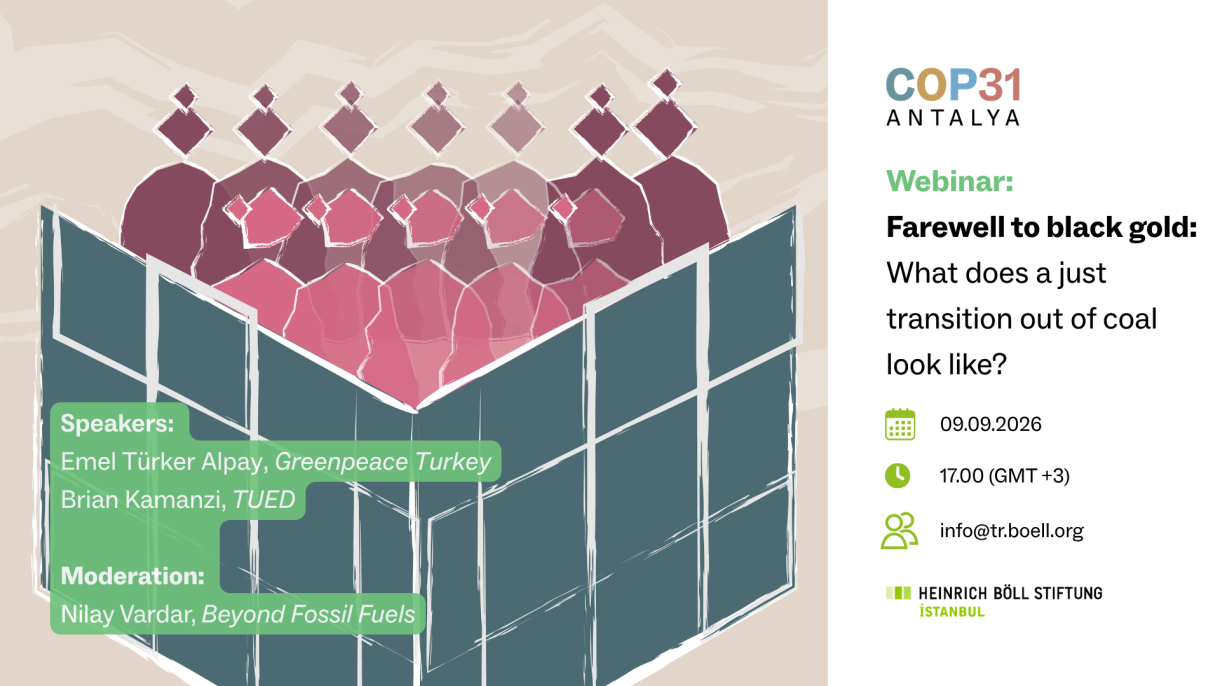
Farewell to black gold: What does a just transition out of coal look like?
As Turkey approaches COP31, the agendas of energy transition, coal phase-out and just transition are moving to the forefront. While the UN report released this week says the 1.5-degree threshold will be crossed within a few years and that warming will peak at 1.8 degrees even in the best-case scenario, civil society is calling on Turkey to take more effective steps on transitioning away from fossil fuels (TAFF) and on just transition policies, both through its COP Presidency role and through its national policies. While Turkey's position on the global fossil fuel phase-out agenda remains cautious; it has announced neither a roadmap nor a date for exiting coal nationally.
Yet the country is in fact leaving coal behind. It is simply not doing so within a defined plan and timetable, supported by social policies; rather, it is doing so by backing renewable energy that market dynamics already favour. The government's own energy plan shows coal's share of electricity generation falling from today's one-third to roughly 14 per cent by 2035. Coal mining has shed around 11,000 jobs in the last two years, with worker protests in nearly every mining region and no policy developed in response.
Meanwhile, new coal investments remain on the agenda. In Çanakkale, a province with five thermal power plants, an environmental impact assessment process is underway for an additional 1,050 MW unit at the Karabiga plant. What is called a "capacity increase" is, by its scale, a new power station. And although thermal plants run predominantly on imported coal, new mining areas such as Akbelen in Muğla are being opened despite strong public objection.
Civil society's demand is clear: an announcement that no new coal plants will be built, cancellation of the planned Afşin plant, and the declaration of a phased exit with a just transition plan behind it. A plan that does not strand workers, local economies and the people who depend on them. As COP31 approaches, part of civil society has written a joint letter to the COP31 Presidency on behalf of local communities in coal regions, calling for no new coal plants or mines to be permitted and for just transition planning to be placed at the centre.
The functions, governance and financing of the just transition mechanism agreed at COP30, which civil society calls the Belém–Antalya Mechanism, will be decided at COP31. While Australia, itself a coal producer, leads these negotiations, Turkey will focus on the energy dimension through the "Clean Energy Transition" heading in its action agenda.
In this instalment of our road-to-Antalya webinar series, we will discuss the demand for a just transition: what such plans need to contain, who will pay for them, and with whose participation they should be prepared. Because there is almost no data in Turkey on women's labour, income and care burden in coal regions, the gender dimension of the transition will also be one of the session's themes.
Emel Türker of Greenpeace Turkey will set out the demands in Turkey and what the picture looks like from the ground in coal regions. Brian Kamanzi of the Trade Unions for Energy Democracy (TUED) network will speak to coal phase-out experiences around the world, and what unions are demanding. The session will be moderated by Nilay Vardar of Beyond Fossil Fuels.
Participants:
Emel Türker Alpay, Climate and Energy Campaigns Manager at Greenpeace Turkey
Emel Türker Alpay has worked on climate change, climate justice and related issues for many years. She holds a Master's degree in human rights law, which she completed on climate justice, and has worked on environmental and climate issues at a range of national and international organisations. She is currently Climate and Energy Campaigner at Greenpeace Türkiye, where she runs campaigns on coal phase-out, a just energy transition and climate change.
Brian Kamanzi, Researcher for Trade Unions for Energy Democracy
Brian Kamanzi is a Researcher for Trade Unions for Energy Democracy based at the City University of New York. He is currently providing technical research inputs to support policy development for unions in the global TUED network in service of campaigns to establish public energy systems with active work involving Unions in South Africa, EU region, and Asia-Pacific Region.This work is currently aiding to improve the capacity of trade union negotiators to participate in local energy transition processes.
Nilay Vardar, Communications Manager at Beyond Fossil Fuels
Nilay is a graduate of the Journalism Department at Galatasaray University and holds a Master's degree in Disability Studies from Istanbul University. She worked as a reporter and editor at bianet between 2011 and 2017, and then spent four years as Communications Officer at Greenpeace Mediterranean. She is currently Communications Manager at the Beyond Fossil Fuels.
Translation: Barış Yıldırım, English
- Timezone
- GMT+3
- Address
-
➽ Online Event
- Organizer
- Heinrich-Böll-Stiftung Istanbul - Turkey
- Language
- English
- Simultaneous translation
- Access
- https://us06web.zoom.us/j/87163945789