
Conference
- Friday, December 11, 2026 4:00 pm – 8:00 pm Save in my calendar
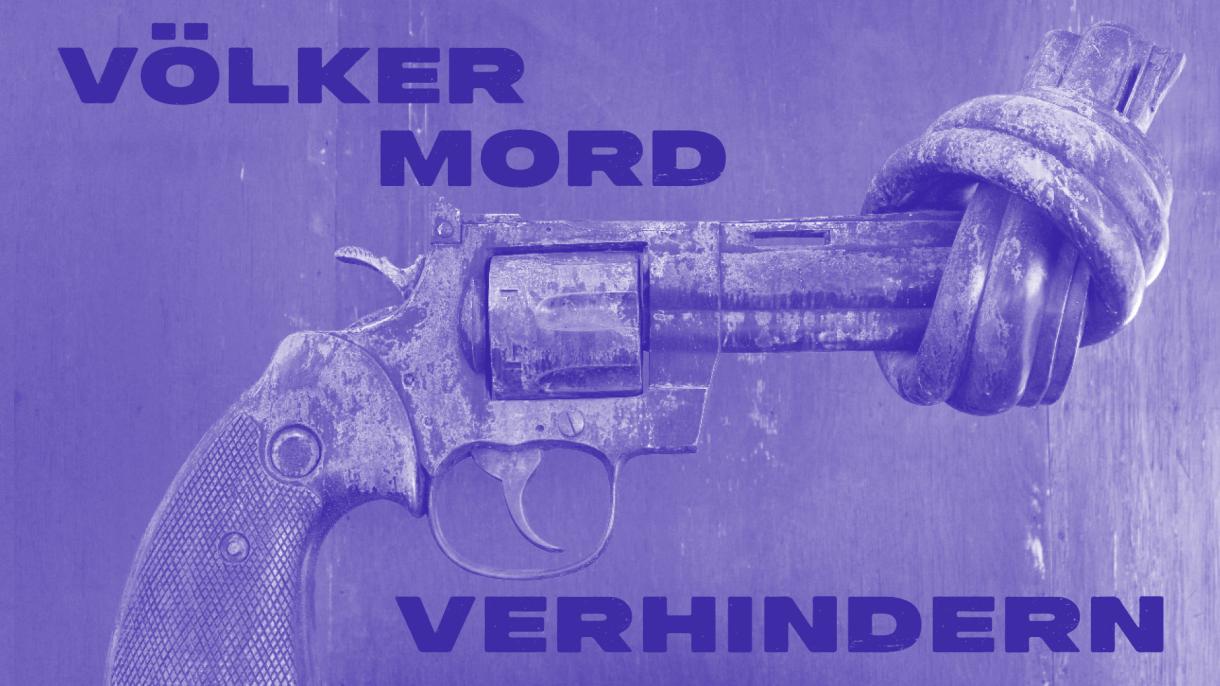
Preventing Genocide
How Germany Can Fulfill Its Duty to Prevent Serious Crimes
“Never again” is the central lesson of the Holocaust. It is also the starting point of our modern international law. The 1948 UN Convention on the Prevention and Punishment of the Crime of Genocide establishes the prevention of genocide as a duty of humanity.
Germany and all 153 other States Parties to the Convention commit to doing everything in their power, in the event of indications of an impending genocide, to avert crimes against humanity—regardless of who the alleged perpetrators and victims are. This applies especially when there is still no legal clarity as to whether the elements of genocide have in fact been met. A final determination is usually not reached until it is too late for any preventive action.
Despite the clear mandate under international law, preventing genocide is difficult in practice—as demonstrated not least by the genocides in Rwanda and Srebrenica. Currently, there are serious indications of possible violations of the Genocide Convention in Myanmar, Ukraine, Sudan, and Gaza. So far, the German government has had only limited success in addressing the political challenges arising from the obligation to prevent genocide. In particular, the response to the Israeli military’s conduct of war in the Gaza Strip has become a litmus test for Germany’s “Never Again” commitment.
The Hamas massacre of October 7, 2023—which also exhibits genocidal characteristics—remains the central focal point in Germany for the political debate on current developments in the Middle East. Based on this logic, the war in Gaza and the alleged war crimes committed there are viewed solely as a consequence of October 7. But the crimes committed by Hamas do not justify further injustices. Legally speaking, these are two separate offenses.
Proceedings against Israel are underway at the International Court of Justice; the International Criminal Court has issued arrest warrants for members of the Israeli government; and human rights organizations and international law experts have leveled numerous allegations of genocide. While this is also the case with regard to Sudan and Myanmar, the political, economic, and military ties between those countries and Germany are nowhere near as close as those between Israel and Germany. As a result, the German government has entirely different levers of influence at its disposal than it does with Myanmar and Sudan. This has already had concrete consequences in foreign policy: Nicaragua has sued Germany at the International Court of Justice for complicity in genocide in Gaza, alleging that Germany failed to use its influence over Israel to protect the Palestinians in Gaza.
Meanwhile, the highly polarized political debate on Gaza in Germany revolves primarily around the question of whether or not it constitutes genocide. The obligation under international law to prevent genocide—regardless of the facts that may later be established in court—takes a back seat. This form of debate fails to do justice to the core purpose of the Genocide Convention—the preventive avoidance of genocide.
The people in Gaza, Sudan, Myanmar, and Ukraine need protection now from impending crimes against humanity. Only political action can prevent genocides and rule out any potential German support for serious international crimes. An open, informed public and political debate is essential for this.
Together with genocide researchers, experts in international law, and political analysts, we want to discuss what Germany must do to fulfill its duty to prevent genocide. What tools does Germany have at its disposal to respond to impending crimes against humanity? How were these instruments used in the case of Gaza, and how do Germany’s options for influence in this case differ from those in the cases of Myanmar, Sudan, and Ukraine? What (legal) evidence is needed for political preventive action? What lessons can we learn from the experiences of Rwanda and Srebrenica? What can, should, and must German policymakers do regarding Gaza at this time?
With:
- Omer Bartov (Historian and professor of Holocaust and Genocide Studies at the Brown University in Providence)
- Kai Ambos (Professor of Criminal Law and Criminal Procedure, Comparative Law, International Criminal Law, and International Law at the University of Göttingen & Judge at the Special Tribunal for Kosovo in The Hague)
- Nahed Samour (Scholar of Law and Islamic Studies, Radboud University)
- Michael Sfard (Human rights attorney and author)
- Sven Kühn von Burgsdorff (A former German diplomat who served, among other posts, as the EU ambassador to Palestine and South Sudan)
- Sophia Maier (Journalist, author, and filmmaker)
Moderation: Benjamin Hammer* (Journalist, Deutschlandfunk)
*tbc
Language: Englisch-German with translation
Information: Bauke Baumann, Senior Programme Officer for Israel, Palestine, Jordan, and Iran, Heinrich-Böll-Stiftung
E-Mail, baumann@boell.de
Telefon +49(0)285 34 -321
- Address
-
Heinrich-Böll-Stiftung - Headquarter Berlin
Schumannstr. 8
10117 Berlin
- Accessibility
- Language
- German
- English
- Simultaneous translation
- Livestream
- Watch livestream
Your participation in the event
On-site participation at the Heinrich Böll Foundation Conference Centre, Schumannstr. 8, 10117 Berlin
Please register. Unfortunately, the number of places is limited. If the room capacity is exhausted, we will broadcast the event via video to other rooms. Please note that there is no guarantee of a place in the hall.
Accessing our building
- The entrance to our building is wheelchair-friendly.
- The front entrance is equipped with an accessible intercom system.
- A parking spot for disabled persons can be provided upon request.
- Our event space is on the first floor (US: second floor).
- The building is equipped with an elevator.
- Accessible toilets / bathrooms are available on the ground floor level.
Wheelchair spaces
In our event spaces we provide dedicated spots for wheelchair users.
All tables come with a wheelchair clearance.
For further questions please contact our event staff.
Further information on accessibility can be found here.
Alternatively, you can follow the event via livestream without registering.