
- Donnerstag, 20. Oktober 2016 – Samstag, 22. Oktober 2016 In meinem Kalender speichern
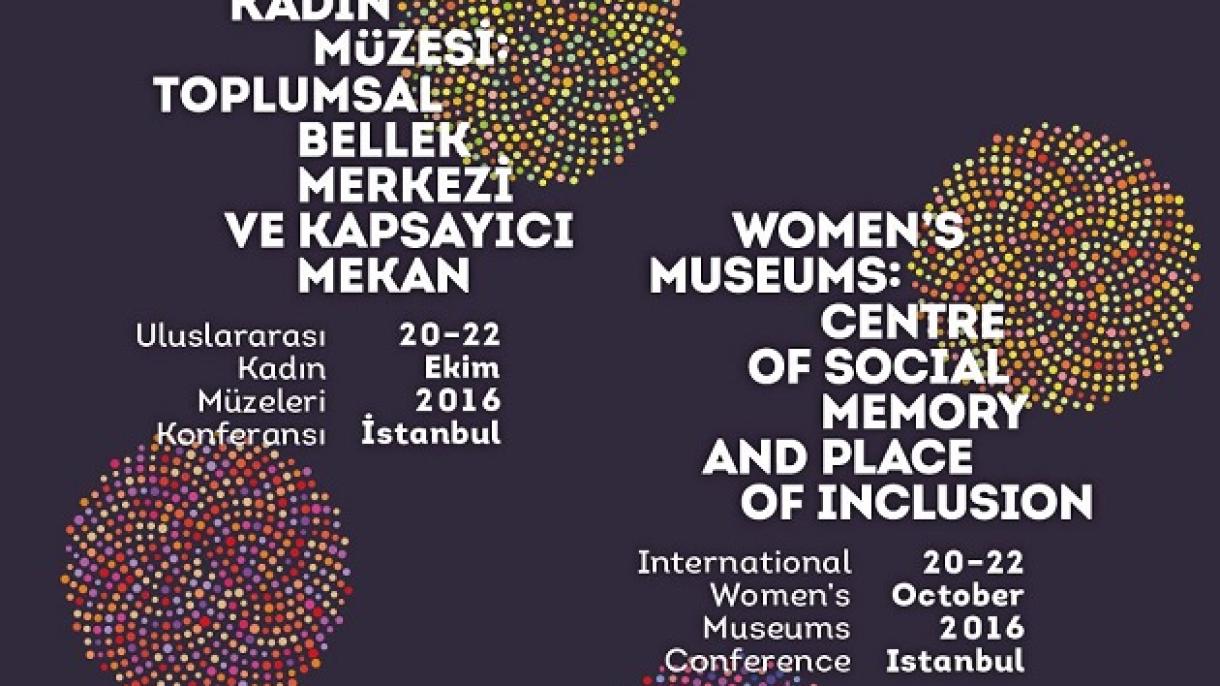
Women’s Museums:
Centre of Social Memory and Place of Inclusion International Women’s Museums Conference
Women's Museums: Centre of Social Memory and Place of Inclusion -International Women's Museums Conference will be 20-22 October 2016.
The conference is aiming to discuss the following points with relation to the role of women's museums in social change, their approach to social memory and inclusive cultural practices:
• Exploring and understanding social memory in women's museums
• Concepts of women's museums to create and re-create the ongoing process of social memory with reference to diversity
• Conceptual approaches of women's museums for inclusive policy in museums
• Cooperation partners of women's museums to transform the museum into a platform for inclusion
• Strategies of women's museums to develop a platform for debate and social involvement
• Concepts of women's museums as a public platform for gender-democratic dialogue
For more information:
www.istanbulkadinmuzesi.org/en
Women’s Museums: Centre of Social Memory and Place of Inclusion -International
Women’s Museums Conference will be organised by the Women’s Museum Istanbul and the Faculty of Communication at İstanbul Bilgi University to examine the contributions of women’s museums as encouraging actors for changes in society in the 21st century.
WHY SUCH A CONFERENCE?
Women’s Museums: Centre of Social Memory and Place of Inclusion – International Women Museum’s Conference is aiming to discuss the following points with relation to the role of women’s museums in social change, their approach to social memory and inclusive cultural practices:
· Exploring and understanding social memory in women’s museums
· Concepts of women’s museums to create and re-create the ongoing process of social memory with reference to diversity
· Conceptual approaches of women’s museums for an inclusive policy in museums
· Cooperation partners of women’s museums to transform the museum into a platform for inclusion
· Strategies of women’s museums to develop a platform for debate and social involvement
· Concepts of women’s museums as a public platform for gender-democratic dialogue
WHAT IS THE ROLE OF WOMEN’S MUSEUMS IN FORGETTING, REMEMBERING, AND DIVERSITY?
Inclusion
Inclusion strengthens cultural diversity and cultural diversity is an important precondition of gender-equal democracy building. Because of their emancipatory concepts women’s museums are corrective institutions. They reshape the traditional perception of history, culture and everyday life and point to alternatives, thus creating an attitude of acceptance and active concern towards others.
Corrective Intervention
Memory and history are not synonymous. Memory is always in the process of being made, it is formed through a constant dialogue in society about forgetting and remembering. Museums are family albums forming the memory of societies, but too often gender-biased and without reflecting ethnic diversity. Corrective intervention of women´s museums for an appreciating communication and respectful contact among the members of society is still needed.
WHAT ARE THE SOCIO-CULTURAL IMPACTS OF WOMEN`S MUSEUMS?
Alternative opposition
Museums were untouchable elite institutions until women’s museums appeared. Following their idea of “herstory” as a cultural alternative to “history” courageous women’s groups established new museums showing women as acting subjects. These museums were mostly created through voluntary work, with very small budgets, but great creativity and incredible persistence.
A new perspective of the past and the present
Even though during the initial phase women’s museums were ridiculed and ignored by local and national administrations as well as traditional museums, the short history of women’s museums shows that they created open forums for all those who show the courage to leave their roots behind and explore new opportunities. They have developed a new language and a gendered view of the conception of history when looking at aspects such as gender discrimination diversity in general, environmental degradation or war and peace.
Catalyst of social change
In 2008 the theme chosen by the International Council of Museums (ICOM) for the International Museum Day was “Museums as Agents of Social Change and Development.” The theme for 2013 was “Museums (memory + creativity = social change)”. In future we will see a still greater focus on links between museums and social issues. Women’s museums with their key concepts and challenges of their ideas can be seen as an especially important catalyst of social change in society.
Enriching debates
Strategies to make women visible and to discuss thinking loops and blockades in displaying women’s history in museums started in the 1980’ies. Feminist women’s studies and feminist history research defined history and the history of women from the women’s point of view, thus opening the path leading to the creation of women’s museums. The first women’s museum which used the definition “Women’s museum” in its name was the Frauenmuseum Bonn established in 1981.
In 2016 there are more than 70 women’s museums worldwide represented on all continents with ethnological, archeological, historical, political content or focussing on women in the arts. In their research and analyses women`s museums draw attention to the interdependence of present and past in women’s lives, show the political, economic, and cultural influences on women’s daily lives, raise consciousness, form memory, offer role models to women and young girls, keep women’s past cultures alive, make modern life of women visible and introduce gender equality into museums.
A place for ideas and actions
Having such aspirations women’s museums are corrective institutions and their influence force traditional museums to transform their perception of society, history, culture and their ideas of what is worth displaying. By doing so women’s museums form positive conditions for a gender-democratic society, opening a space for discussion and action.
While in the beginning of the 1980s discussions about women’s museums were mainly focussed on the representation of women in traditional museums, women’s museums in the 21st century deal with key issues of women’s lives such as “power”, “politics”, “economics”, “culture of remembrance”, “identity”, “diversity” and “inclusion[1]”.
Social memory is an active and ongoing process and it must be created and recreated. By rewriting women’s history and making the performance and contributions of women of different cultural, ethnic and religious backgrounds visible women’s and gender museums are a mirror of societies and social changes. Women’s museums are also inclusive institutions. They seek ways to achieve cultural inclusion by representing those who are often excluded in the women’s memory, thus offering an opportunity for them to participate.
WHAT IS THE SIGNIFICANCE OF THE CONFERENCE IN ISTANBUL FOR WOMEN’S MUSEUMS?
Women’s museums have met multiple times. During these meetings, the organisational problems of women’s museums were given primary importance. Although many women’s museums have developed inclusive content in different topics over the years (and some were even founded for the specific purpose of being inclusive), the conference in Istanbul will debate about the various concepts of inclusion practiced in women´s museums for the first time [2].
We believe after 40 years of women’s museum experience, time has come for us to analyze and discuss the contribution of women’s museums to the concept of social inclusion at an international meeting.
WHAT ARE THE GOALS OF THE CONFERENCE?
· To bring women’s museums from different countries of the world together to discuss their concrete projects realising “Social Memory” and “Inclusion” as goals and organisational principles;
· To share experiences of women’s museums about displaying different cultures or cultural identities within a society;
· To provide a platform to address theory, criticism and practice in displaying history, art, gender and the reflection of society;
· To establish networking within the women’s museums working on the principles of inclusion, diversity and remembrance;
· To bring Turkish curators together with colleagues from different countries to create lasting relationships and to foster discussion of joint projects.
WHY THE CONFERENCE WILL START WITH A DEBATE ON INTERSECTIONALITY?
The theory of intersectionality draws attention to the relationship between different levels of social identities. Rethinking the plurality of social identities with the idea of a women’s museum in mind will show us what is easily forgotten. Being a women’s museum does not directly make a museum inclusive. Among women’s museums, there are museums that still work within the official history framework or that do not reflect different female experiences.
The debate in the opening session will enable representatives of women’s museums to think about the concept of their own museum. The debate aims at showing up ways women’s museums could use to avoid biases. It will establish a general framework for the concepts used in exhibiting different female experiences and for the inclusive approach to social memory.
[1] We use the criteria for the term “inclusive museum” in accordance with the ICOM Cultural Diversity Charter (2010); UNESCO Universal Declaration on Cultural Diversity (2001). An inclusive museum includes marginalized individuals or groups in its exhibitions, and gives the opportunity for cultural participation and visibility.
[2] The International Association of Women’s Museums (IAWM) was established in 2012. Every second year there is an Association Meeting in a different host country. These meetings discuss topics such as the acceptance of women’s museums, initiate collaboration between the women’s museums and plan the next conference.
Apart from the IAWM meetings, an additional meeting in Vienna named “Women: Museum, Collection Strategy, and Social Platform” was organized in 2010 by Gesellschaft für Kulturanalytik. Artists, cultural managers and scholars discussed the role of women’s museums in cultural policies.
Concept: Meral Akkent, Women’s Museum Istanbul
For further information: bilgi.ikm@gmail.com
ORGANIZING INSTITUTIONS
Women’s Museum Istanbul
“Inclusion” is an ideal as well as an organisational principle for the Women’s Museum Istanbul. The museum’s work is a contribution to creating an inclusive women’s history of the city of Istanbul. The Women’s Museum Istanbul is a community and non-profit organization, the first museum of its kind to be established in Turkey. It opened on September 25, 2012 as a virtual museum with a well-designed website written in Turkish and translated into three other languages: English, German, and Italian.
The museum, operating on a voluntary basis, is dedicated to the more than 2600 years of Women’s history in the city of Istanbul and to the role played by women in the vibrant and multi-textured life of the city. The museum aims – in the long run – at having a building of its own.
The aim of the museum is to provide a showcase for the history of women in Turkey, a history which was lost, obscured or disowned all too quickly by the mainstream of opinion, and to share this history as a counterpart to male-dominated historical writing, thus creating an inspiring new cultural model. The memory of the city’s women is kept alive through exhibitions that honor, inform and provide role models from women’s history. The Women’s Museum Istanbul is envisioned as a project to create and encourage understanding and dialogue among the generations, genders and among the different cultural and ethnic groups of the city.
The Women’s Museum Istanbul communicates with visitors via its Facebook and Twitter accounts and offers a “Mini Education Program” every day using biographies in the permanent (virtual) exhibition in Turkish, English and German languages.
The museum organises international meetings within the framework of the museum’s “Women’s Cultural Heritage Program”. In this context the following international meetings were organized in partnership with Sabanci University and Koc University:
2013: “Semiha Es – International Symposium on Women Photographers” commemorating the 100th anniversary of Semiha Es, the first war photographer of the Turkish press.
2014: “The International Symposium on Gender Equality at the Academy – Best Practices” on the occasion of the 100th anniversary of women at the university in Turkey.
The website of the museum:
www.istanbulkadinmuzesi.org/en
Facebook account of the museum:
www.facebook.com/IstanbulKadinMuzesi
Promotional video of the Museum: